
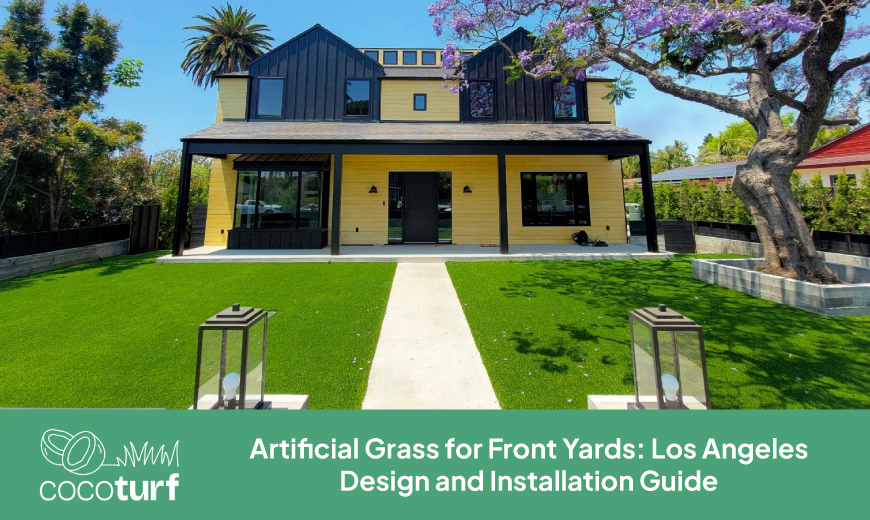
A front yard has a different job than almost any other part of the property. It needs to look polished from the sidewalk, complement the architecture, and stand up to Southern California sunshine without becoming another high-maintenance landscaping project.
Well-designed artificial grass for front yards can provide consistent greenery while eliminating mowing and greatly reducing the water required to maintain a conventional lawn. The most convincing results come from treating turf as one element of the landscape rather than covering every available inch in green.
Professional front yard turf installation also considers what people see from the street. Blade direction, seams, edges, transitions, planting beds, walkways, and driveway borders all contribute to whether the finished landscape appears natural and appropriate for the home.
Why Los Angeles Homeowners Are Replacing Front Lawns
Maintaining a lush natural lawn in Southern California can require significant irrigation, routine mowing, fertilizing, edging, and ongoing attention.
A front lawn replacement in Los Angeles can reduce those maintenance demands while keeping a green element in the landscape throughout the year. Turf can also eliminate common problems such as worn areas near walkways, muddy spots, and uneven sections caused by inconsistent grass growth.
The goal does not have to be an entirely synthetic landscape. Combining turf with drought-conscious planting and hardscape can create a more layered, upscale appearance.
Choosing Blade Color and Texture for Street-Side Curb Appeal
Real grass is not one uniform shade of green. That is one reason overly bright or perfectly consistent synthetic lawns can look artificial from the street.
Realistic artificial grass typically combines different shades, blade shapes, heights, and thatch tones to create greater visual depth. The best choice should also complement the home’s architecture and surrounding landscaping.
Curb appeal artificial grass should look convincing from multiple viewpoints, including the sidewalk, driveway, front entrance, and street. Samples are useful, but evaluating them outdoors in natural sunlight provides a much better sense of how the finished lawn may appear.
Designing around Walkways, Driveways, and Planting Beds
A front yard usually contains more interruptions than an open backyard. Driveways, pathways, steps, utility boxes, trees, planting beds, mailboxes, and property boundaries all affect the turf layout.
Artificial grass for front yards can be shaped around these elements to create clean transitions without making the landscape appear overly segmented.
Curves can soften large expanses of turf, while crisp straight lines may better complement modern architecture. Existing trees need appropriate space around their trunks and roots, and planting beds should be designed so soil, mulch, and organic debris do not constantly spill onto the turf.
Pairing Turf with Drought-Tolerant Plants and Hardscape
A drought-tolerant front yard in Los Angeles does not have to mean choosing between an all-turf lawn and an entirely gravel landscape.
Artificial grass can provide the green foundation while drought-tolerant plants, ornamental grasses, succulents, stone, pavers, and other hardscape add texture and dimension. This combination can also reduce the amount of turf required while giving the yard a more custom appearance.
Organic infill made from coconut husks and cork can further distinguish a premium turf system from conventional installations that rely on traditional rubber-based infill. These natural materials can retain moisture and support evaporative cooling while contributing to a softer, more natural-feeling surface.
Edging, Seams, and Blade Direction on Highly Visible Lawns
Small installation details become especially noticeable in a front yard because the landscape is viewed from predictable angles every day.
Blade direction influences how light reflects from the fibers and how full the lawn appears from the street. Installers should plan orientation before cutting the turf rather than deciding after sections are already positioned.
Seams should also be placed strategically. Poor alignment can create visible lines that interrupt the lawn’s natural appearance.
Front yard turf installation requires equally careful attention around driveways, sidewalks, planters, and borders. Clean edging helps prevent lifting and gives the lawn the tailored finish expected in a highly visible area.
HOA Rules and California Civil Code 4735
Homeowners in HOA communities should review their association’s current landscaping standards before beginning a project.
According to California Public Law, California Civil Code Section 4735 limits certain HOA restrictions related to water-efficient landscaping and, under specified circumstances, artificial turf or synthetic surface installations. However, the law does not mean every turf design is automatically exempt from reasonable association standards. Homeowners should review the current statute, governing documents, and architectural approval process applicable to their property before installation.
Searches for HOA artificial turf California law often lead homeowners to statewide rules, but individual associations may still have design requirements involving appearance, installation quality, materials, or project approval. Getting those details before selecting turf can prevent unnecessary redesign later.
Front Yard Installation Steps and Timeline
A professional installation begins long before the grass is rolled into place.
The process generally involves:
- Evaluating the existing lawn and drainage
- Planning turf orientation, seams, and transitions
- Removing existing grass and unsuitable material
- Preparing and compacting the base
- Establishing appropriate grading and drainage
- Cutting and fitting the turf
- Securing seams and perimeter edges
- Adding the specified infill
- Brushing and finishing the fibers
- Inspecting transitions and final details
Site size, access, existing landscape conditions, drainage needs, and design complexity influence the project timeline.
For artificial grass for front yards, careful preparation is worth the attention because uneven base work or rushed seams can remain visible from the street long after installation is complete.
Creating Curb Appeal with Front Yard Turf Installation
The strongest front-yard designs do not attempt to imitate a perfectly flat rectangle of conventional lawn. They use turf as part of a larger landscape composition.
A narrow turf panel between planting beds can highlight a modern walkway. Curved green areas can soften a traditional home. Turf between oversized pavers can create a more architectural entrance, while strategically placed drought-tolerant plants can add height and seasonal interest.
The result should complement the property rather than compete with it. Premium fibers, realistic variation, precise installation, organic materials, and balanced landscaping can give the front yard a finished appearance that remains inviting from the curb to the front door.
Frequently Asked Questions
Is artificial grass a good option for a Los Angeles front yard?
It can be an effective option for homeowners who want consistent greenery with less irrigation and lawn maintenance. Product quality, installation, drainage, and landscape design all affect the finished appearance.
How do I keep front yard artificial grass from looking fake?
Choose turf with varied blade colors, realistic texture, appropriate density, and natural-looking thatch. Blade direction, seams, edging, and surrounding plants also make a substantial difference.
Can artificial grass be combined with drought-tolerant landscaping?
Yes. Turf can be paired with succulents, ornamental grasses, drought-tolerant shrubs, stone, pavers, and other hardscape to create a layered landscape with less reliance on a traditional lawn.
Can an HOA prevent me from installing artificial turf in California?
California Civil Code Section 4735 places limitations on certain HOA landscaping restrictions, but homeowners should still review the current law and their association’s architectural and landscaping requirements before beginning a project.
How long does a front yard turf installation take?
The timeline depends on yard size, site access, demolition, drainage, base preparation, design complexity, and other property conditions. A site-specific evaluation provides the most useful estimate.
Summary
A successful Los Angeles front yard combines curb appeal with materials selected for the realities of Southern California landscaping. Realistic fibers, precise seams, proper blade direction, strong base preparation, organic coconut husk and cork infill, and thoughtful integration with plants and hardscape can produce a sophisticated alternative to a conventional lawn. Front yard turf installation should be planned around the entire property, from drainage and walkways to architectural style and HOA requirements, so the finished landscape looks designed rather than simply covered in synthetic grass.
Give Your Front Yard a Better First Impression
With Cocoturf, you are able to turn a thirsty or difficult-to-maintain lawn into a polished landscape that stays green without demanding traditional lawn care. Premium turf, organic materials, natural textures, and carefully planned installation can create a front yard that complements your home from the sidewalk all the way to the front door. To start designing a front yard made for Southern California living, call (310) 957-1900.