
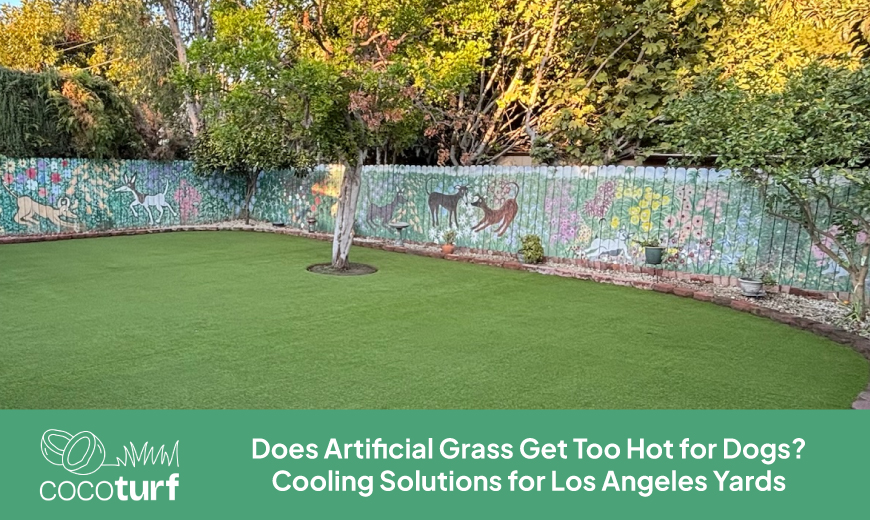
If you own a pet, you may be wondering, does artificial grass get too hot for dogs? It can. Like concrete, asphalt, decking, and other outdoor surfaces, synthetic turf exposed to intense direct sunlight can become much warmer than the surrounding air. For dogs, that matters because their paws come into direct contact with the surface.
The good news is that turf temperature is not determined by the grass fibers alone. Infill, moisture, shade, fiber construction, airflow, and the surrounding landscape all influence how a dog area feels during a hot Los Angeles afternoon.
Homeowners looking for cool artificial grass for dogs should pay particular attention to the entire turf system. Organic infill made from materials such as coconut husks and cork can retain moisture and support evaporative cooling, providing an alternative to conventional infill products that may retain more heat.
How Hot Artificial Grass Can Get during Los Angeles Summers
Synthetic turf temperatures can rise significantly above air temperature when exposed to strong direct sun. The exact temperature varies with the turf product, infill, time of day, surrounding surfaces, airflow, moisture, and weather conditions.
A dog run surrounded by concrete walls and hardscape may experience more reflected heat than a shaded lawn bordered by plants. Dark surfaces nearby can also contribute to the overall heat load.
Pet-friendly artificial grass in Los Angeles should therefore be selected for the specific yard rather than treated as a one-product-fits-all solution. Sun exposure at 2 p.m. can be more informative than how comfortable the same spot feels early in the morning.
Signs Your Dog Is Uncomfortable on a Hot Surface
Dogs cannot tell you that the ground is becoming uncomfortable, but their behavior can.
Watch for signs such as:
- Quickly lifting or alternating paws
- Refusing to walk onto the turf
- Moving rapidly toward shade
- Licking or chewing at the paws
- Limping after being outside
- Seeking cooler concrete, soil, or another surface
- Unusual hesitation in a normally familiar play area
Dog paw burns on turf are a reason to take surface temperature seriously rather than judging conditions only by air temperature.
If you are uncertain about a surface, check it before allowing prolonged play. Dogs should always have access to water and a cooler or shaded place to move away from direct sun.
Cooling Infill Options Built for Pet Turf
Infill sits between the turf fibers and plays several roles in the performance of an artificial lawn. Depending on the system, it can support the blades, add stability, assist with drainage, and influence how the surface manages heat.
Coconut husk infill for pet turf offers a natural approach to temperature management. Coconut-based materials can retain moisture, which can then support evaporative cooling as that moisture is released.
Cork can also be incorporated into an organic infill system. Together, coconut husks and cork provide an alternative to conventional rubber-based infill while creating a more natural-feeling surface.
Pet turf cooling infill works best as part of a complete design. Drainage, airflow, shade, irrigation or rinsing practices, and turf construction should all complement the infill rather than expecting one material to solve every heat issue.
How Turf Color and Fiber Design Affect Heat Retention
Not all artificial grass is constructed the same way.
Fiber shape, density, pile height, color, backing, and infill can influence how a turf system responds to sunlight. Extremely dense turf may behave differently from a more open construction that allows greater airflow through the blades.
Color matters visually and thermally as well. A realistic lawn usually combines several shades rather than relying on one dark, uniform green.
Homeowners comparing cool artificial grass for dogs should look beyond softness in the showroom. Ask how the complete product is intended to perform in direct sunlight and which infill and installation system is recommended for pet areas.
Shade, Misting, and Rinsing Strategies for Dog Areas
Landscape design can do a great deal of the cooling work.
Providing shade for a dog run can reduce direct solar exposure during the hottest portions of the day. Depending on the property, shade may come from trees, covered patios, pergolas, sails, umbrellas, or other structures.
Lightly rinsing turf can also provide temporary cooling, particularly when paired with moisture-retaining organic infill. A misting system may be another option for frequently used pet areas.
Consider where your dog naturally likes to spend time. Placing beds, water bowls, and rest areas in shaded locations gives pets alternatives when sunny portions of the yard become warm.
Cool artificial grass for dogs works best when material selection and landscape planning support each other.
Inland Valley Heat Versus Coastal Neighborhood Conditions
Los Angeles does not have one uniform summer climate.
Coastal neighborhoods can experience very different afternoon conditions from inland communities where temperatures climb substantially higher. A yard’s orientation, surrounding buildings, elevation, vegetation, and hardscape create additional microclimates even within the same neighborhood.
That makes site-specific planning important when someone asks, does artificial grass get too hot for dogs? A turf system that performs comfortably in a partly shaded coastal yard may face very different heat exposure in an inland yard surrounded by masonry and full afternoon sun.
For hotter locations, organic cooling infill, strategically planned shade, access to water, and occasional rinsing can work together to make the pet area more comfortable.
Designing Pet-Friendly Artificial Grass in Los Angeles
A good dog-friendly yard should address more than temperature. Dogs run, dig, urinate, play, and repeatedly use the same routes, which can put considerable demands on a landscape.
Drainage is particularly important. The turf system should allow liquids to move through efficiently, while appropriate maintenance helps control odors and keeps heavily used areas clean.
Material selection also matters when dogs spend significant time directly on the surface. An organic system using coconut husks and cork can avoid the need for traditional crumb rubber infill while contributing to heat management.
For homeowners wondering does artificial grass get too hot for dogs, the better question may be how the entire yard can be designed to manage heat. Turf, organic infill, drainage, shade, water, and thoughtful placement of pet areas can work together to create a lawn that looks refined while remaining practical for four-legged family members.
Frequently Asked Questions
Can artificial grass burn a dog’s paws?
Any outdoor surface that becomes sufficiently hot can injure paw pads. Check exposed surfaces during hot weather and provide dogs with access to shade, water, and cooler areas.
Does coconut husk infill help keep pet turf cooler?
Coconut husks can retain moisture and support evaporative cooling as that moisture is released. Performance depends on the complete turf system, weather, moisture levels, sun exposure, and other site conditions.
Should I hose down artificial grass before my dog goes outside?
Rinsing can temporarily reduce surface temperature and may complement moisture-retaining organic infill. It is still important to check the surface before allowing a dog to remain on it during very hot weather.
Is artificial grass suitable for dogs in hotter inland Los Angeles neighborhoods?
It can be, but hotter locations require careful planning. Turf selection, organic cooling infill, shade, drainage, water access, and the amount of direct afternoon sun should all be considered.
What else should I look for in pet turf besides temperature?
Look at drainage, materials, durability, cleanability, infill, odor management, softness, and how the turf will handle the dog’s normal traffic patterns and habits.
Summary
Artificial turf can become hot in strong Los Angeles sunshine, but surface temperature is influenced by much more than the grass itself. Turf construction, organic infill, moisture, shade, airflow, reflected heat, and yard design all affect comfort. Coconut husks and cork can provide a natural moisture-retaining infill option that supports evaporative cooling, while shade and strategic rinsing can further reduce heat exposure. For dog owners, a thoughtfully designed turf system can combine a polished lawn appearance with practical features that make the yard more comfortable for everyday play.
Best Pet-Safe Artificial Turf Installation Services
Transform your outdoor space with top-quality, pet-friendly artificial turf installation for a crisp, cool, safe area that has the look and feel of real grass. Dogs stay comfortable with this surface that is an average of up to 40 degrees cooler than traditional synthetic turf products. Count on long-term performance with Cocoturf that’s comprised of non-toxic, organic materials. If you want the best pet-safe artificial turf, contact us at (310) 957-1900.